Table of Contents
- 15.1. Tests & Requirements
- 15.2. Begin Module 15. Data Export and DFsas.
- 15.3. Export date values in calender format and save the exported data to a file on the local computer.
- 15.4. Export date values from the database and save the exported data to a file on the local computer.
- 15.5. Examining data values according to user-specified criteria.
- 15.6. Query the database for specific data values.
- 15.7. Create a DFsas job file according to user-specified criteria.
- 15.8. Create a SAS job file and data files using the DFsas job file criteria.
- 15.9. Compare the contents of SAS data files with the actual data in the database.
- 15.10. End Module 15. Data Export and DFsas.
Export date values in calender format and save the exported data to a file on the local computer.
Export date values from the database and save the exported data to a file on the local computer.
Examining data values according to user-specified criteria.
Query the database for specific data values.
Create a DFsas job file according to user-specified criteria.
Create a SAS job file and data files using the DFsas job file criteria.
Compare the contents of SAS data files with the actual data in the database.
Estimate of Time Required: 30 Minutes
-
Start DFATK as described in Module 1 (Installation & Initialization).
-
Click followed by to begin this module.
-
Click to email a copy of ID99006_diary.pdf to
data_manager. Clicking more than once will result in multiple pages arriving to your email inbox.![[Note]](../../imagedata/note.png)
Note Refer to Section 1.8, “Creating user accounts and assigning study permissions.” as a valid email address is required for
data_managerto receive the module specific PDF files.Wait 2-3 minutes prior to proceeding to DFexplore.
All data exported in the following tests will be output to the DFexplore List View screen rather than saved to a file. List View does have 3 save options: Export Data, Save Data Retrieval File and Save As PDF.
-
Start DFexplore, login as user
data_managerand choose 254 Acceptance Test Study as described in Section 1.7, “How to start DFexplore”. -
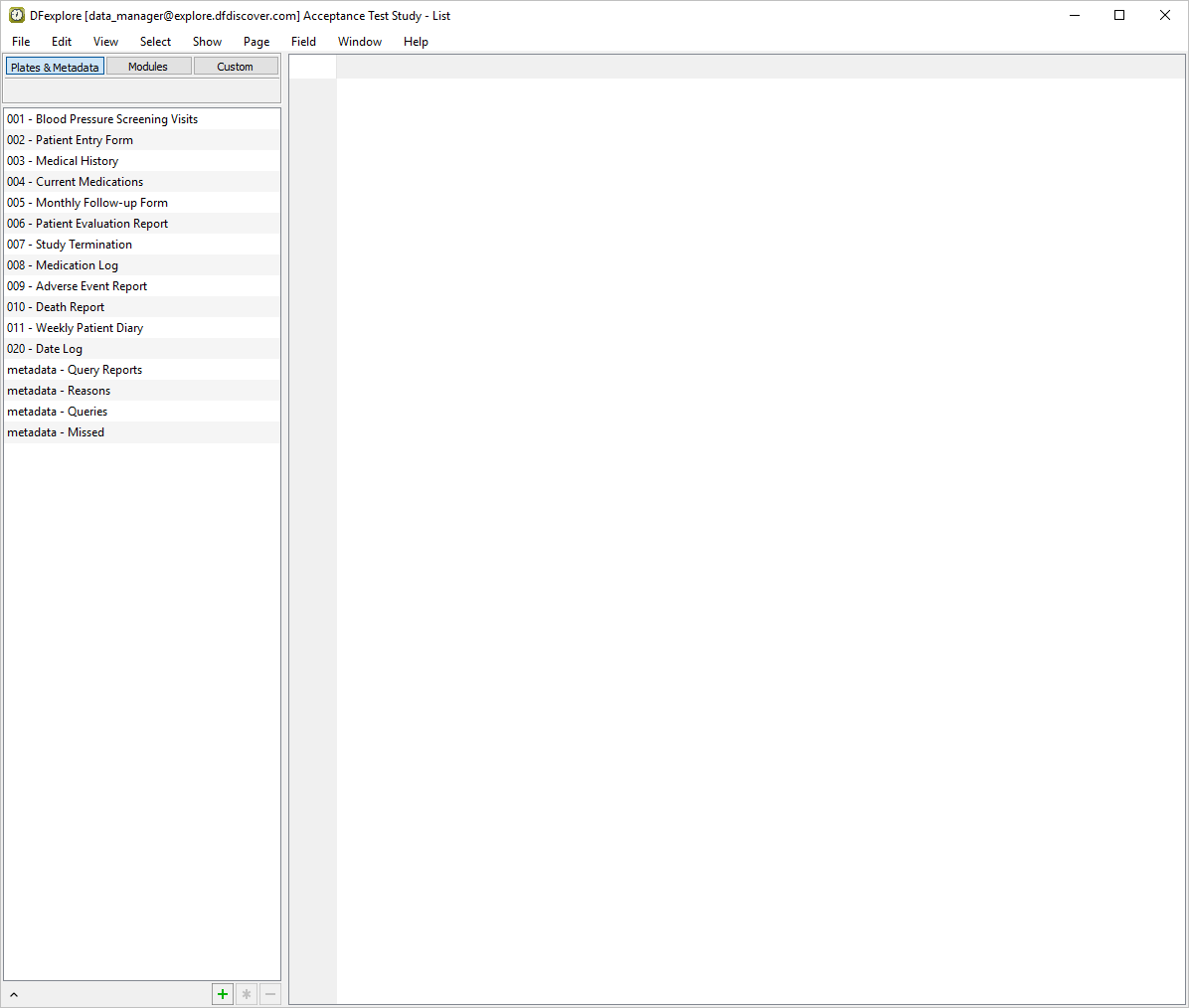
Select > .
-
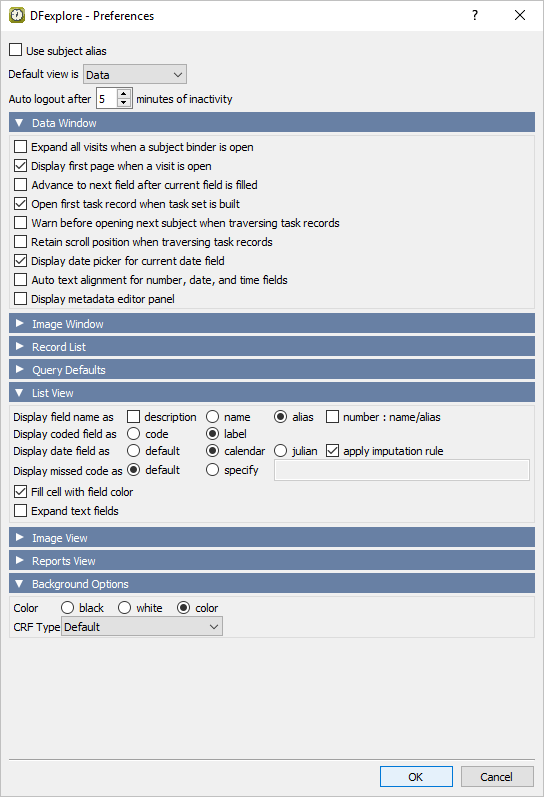
Select > . In the dialog, locate the List View panel. Click
 and enter the List View settings as follows:
Display field name as = alias
Display coded field as = label
Display date field as = calendar
Check (enable) apply imputation rule
Display missed code as = default
Check (enable) Fill cell with field color
Uncheck (disable) Expand text fields
-
Click to close the dialog.
-
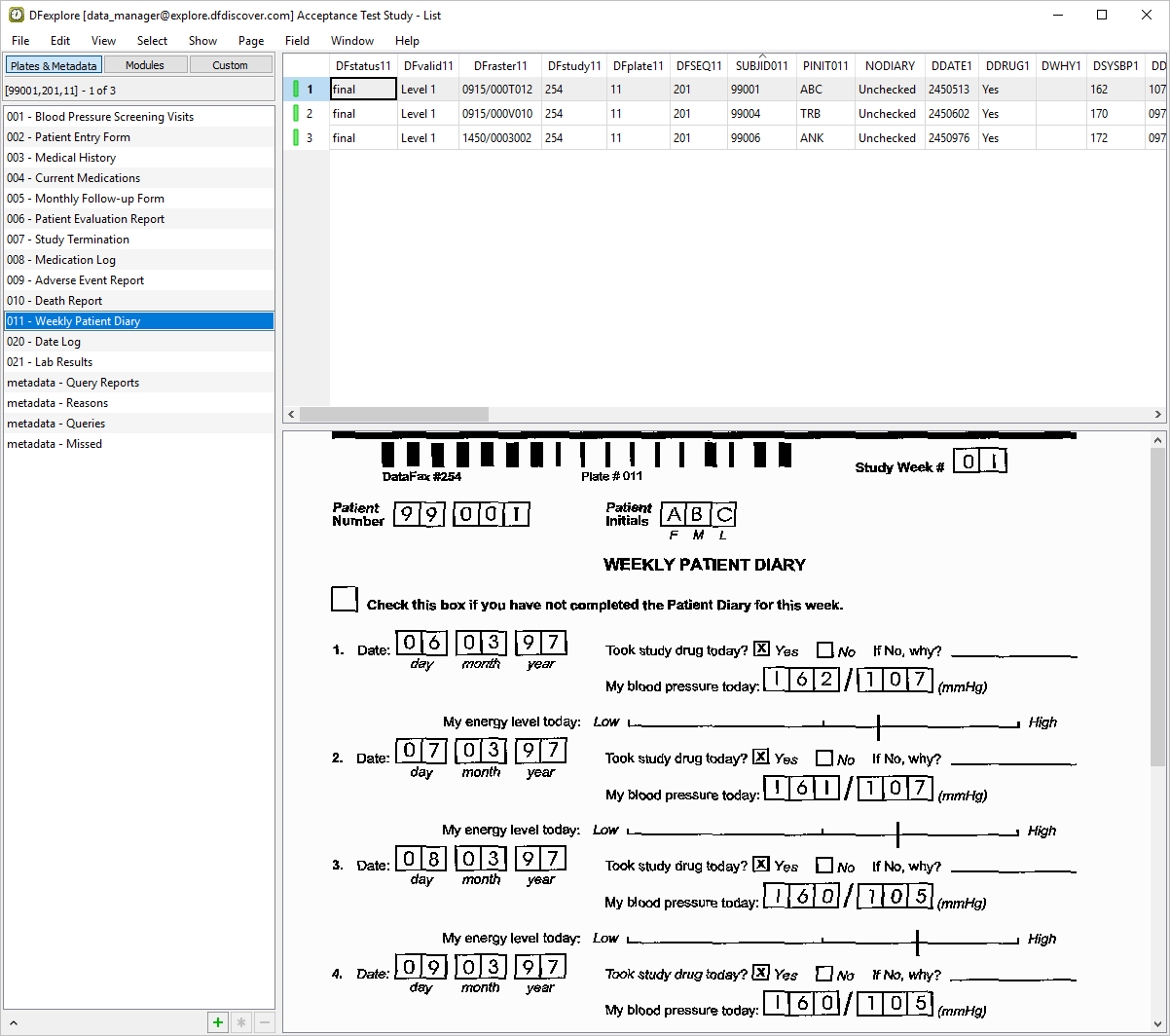
In the main List View window, Plates & Metadata panel, click 011 - Weekly Patient Diary.
-
Select > to show the listing of all data fields and their metadata properties defined for the plate. In the Data Fields window, click
 next to fields 7:SUBJID011,10:DDATE1,16:DDATE2,22:DDATE3,28:DDATE4,34:DDATE5,40:DDATE6
and 46:DDATE7. The fields are added to the Display Fields window.
next to fields 7:SUBJID011,10:DDATE1,16:DDATE2,22:DDATE3,28:DDATE4,34:DDATE5,40:DDATE6
and 46:DDATE7. The fields are added to the Display Fields window.
Note Alternatively fields can also be added by dragging-and-dropping the desired fields from the Data Fields or Metadata Fields windows to the Display Fields window.
-
Click to apply the field selection criteria and close the dialog.
-
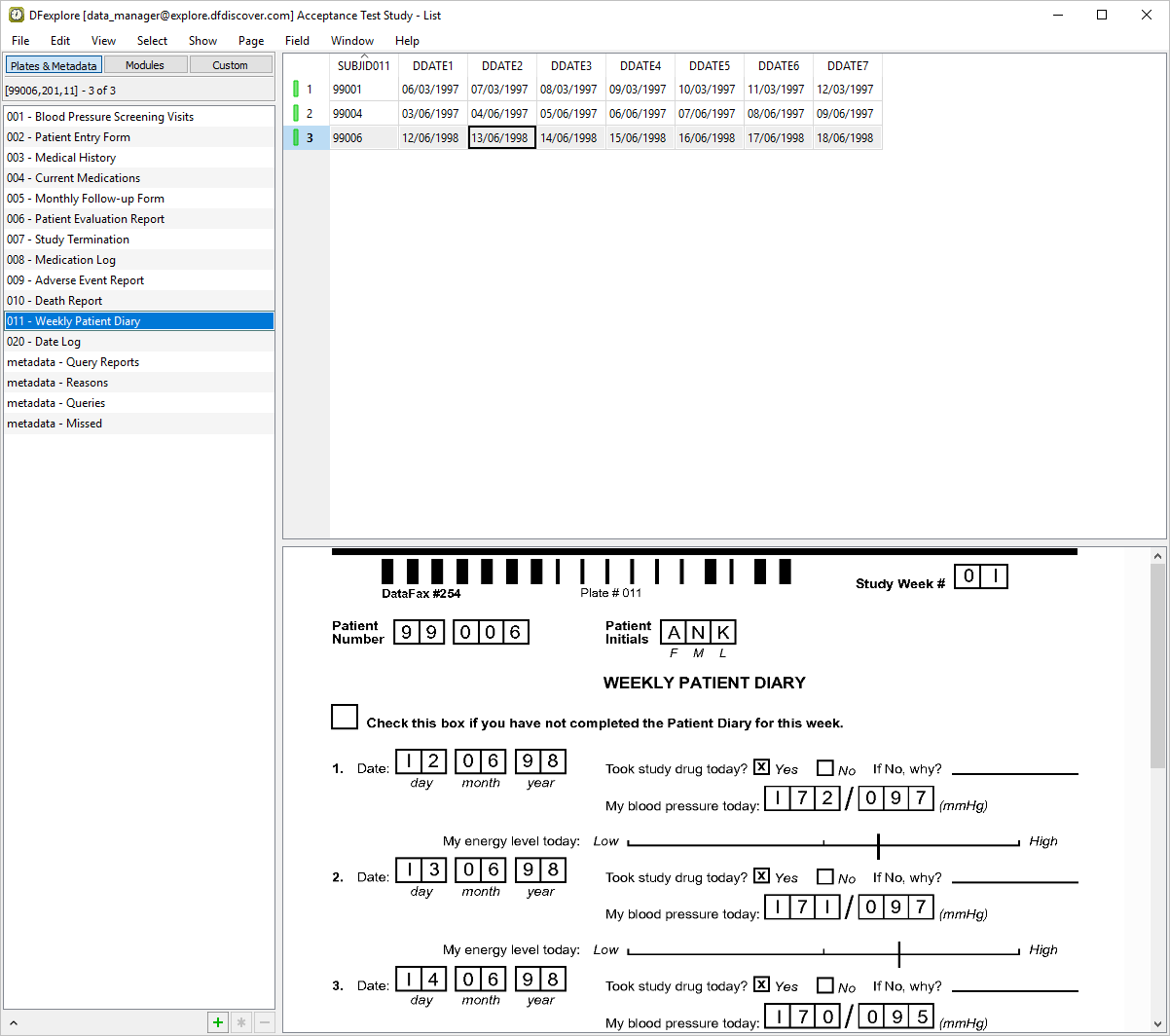
Examine each of the exported date fields. Locate the field column for DDATE1 in the table. This is field 10, 1. Date on the WEEKLY PATIENT DIARY page. In Section 3.12, “Submit a copy of the newly defined Plate 11 into the study database and retrieve the page in DFexplore Image View.” this field was defined with the format
dd/mm/yy(a 2-digit year). Verify that field 10 has been correctly exported in calendar (4-digit year) format. -
Double-click DDATE1 cell for ID 99006 in the table. This takes you to the corresponding date field in the WEEKLY PATIENT DIARY page in Data View. Confirm that the date values are the same as those on the printed WEEKLY PATIENT DIARY for Subject 99006.
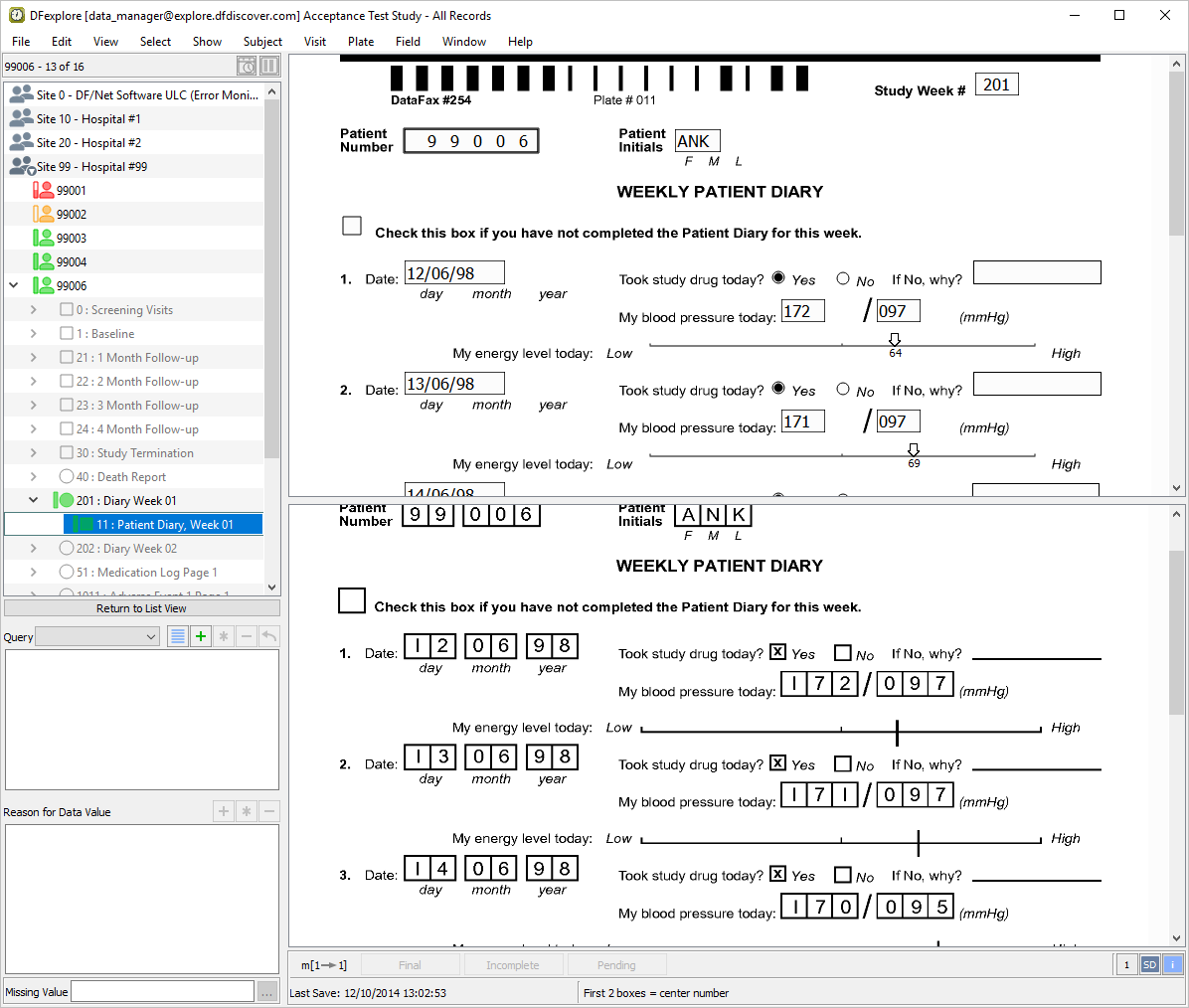
-
In the record list, click to be taken back to the date fields in List View. Confirm that the date values displayed are the same as those on the printed WEEKLY PATIENT DIARY, except now in calendar (4-digit year) format.
-
Select > . In the List View panel, choose julian as the value of Display date field as. Click to apply the settings and close the dialog. Confirm that the exported date values are now in julian format.
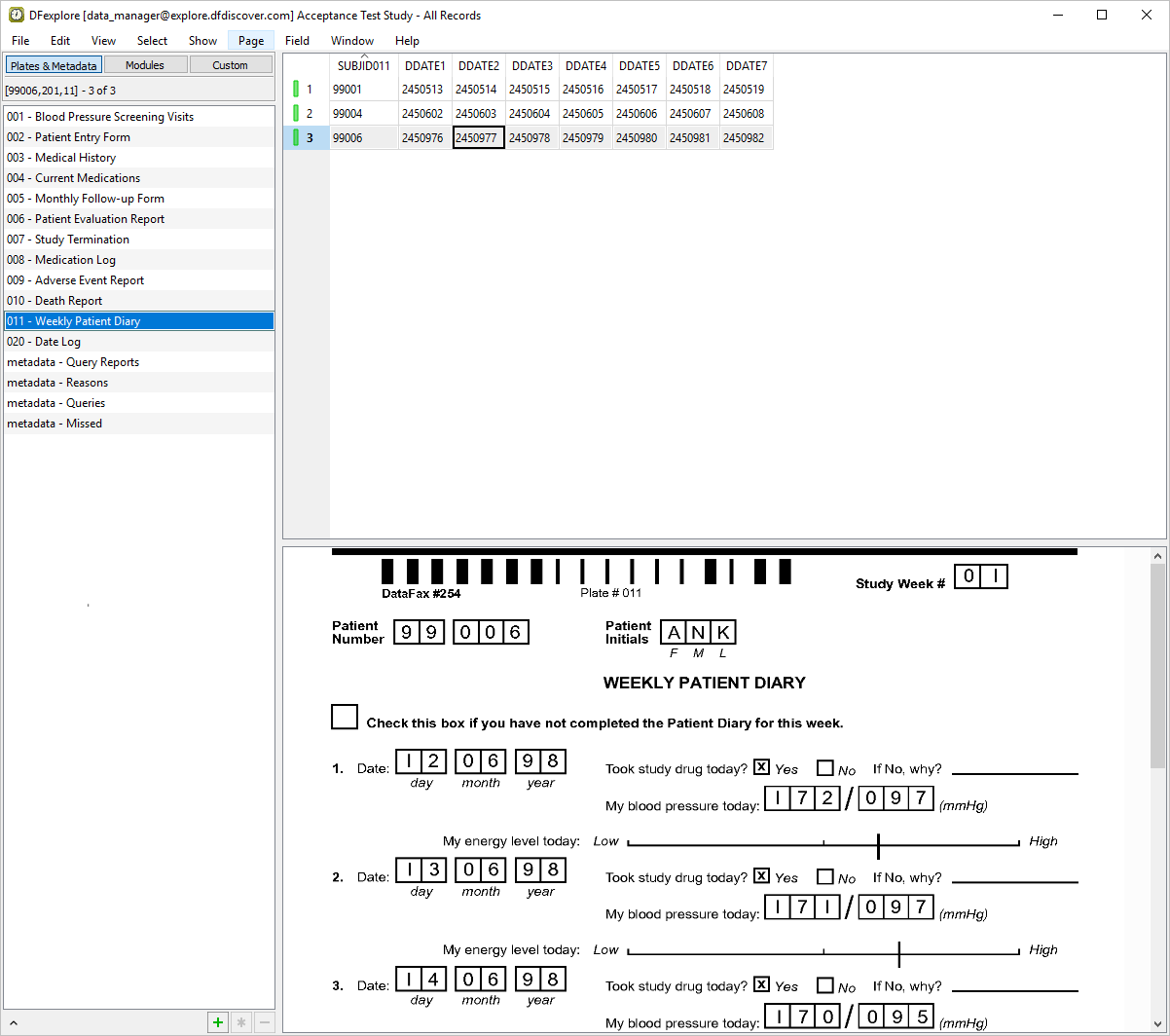
-
Select > to save the dates to a local file. In the dialog, set:
Format = Excel
Check (enable) Include header as the first record in output file
Check (enable) Open output file after export
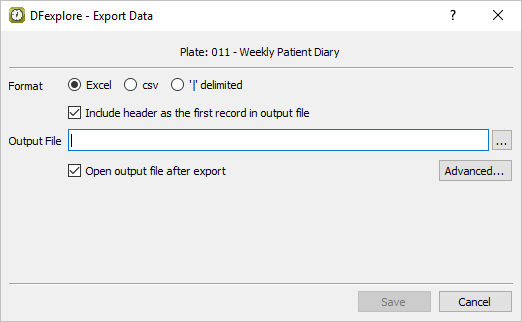
-
Click next to Output File. Choose a directory in the file selection dialog, enter
module15_dates.xlsxas the filename, and click . Click to create/write the file and close the dialog.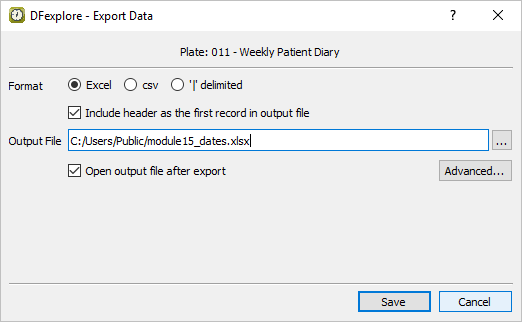
-
The file
module15_dates.xlsxopens. Confirm the contents and then close the file.
-
From the list of plates, select plate 001 - Blood Pressure Screening Visits to make it current.
Select > . In the Data Fields window, click
next to fields
7:SUBJID001,8:PINIT001,9:AGE,10:SEX. The fields are added to the Display Fields window. Note Fields can also be added by dragging-and-dropping the desired fields from the Data Fields or Metadata Fields windows to the Display Fields window.
-
Click to apply the field selection criteria and close the dialog. Examine each of the data fields.
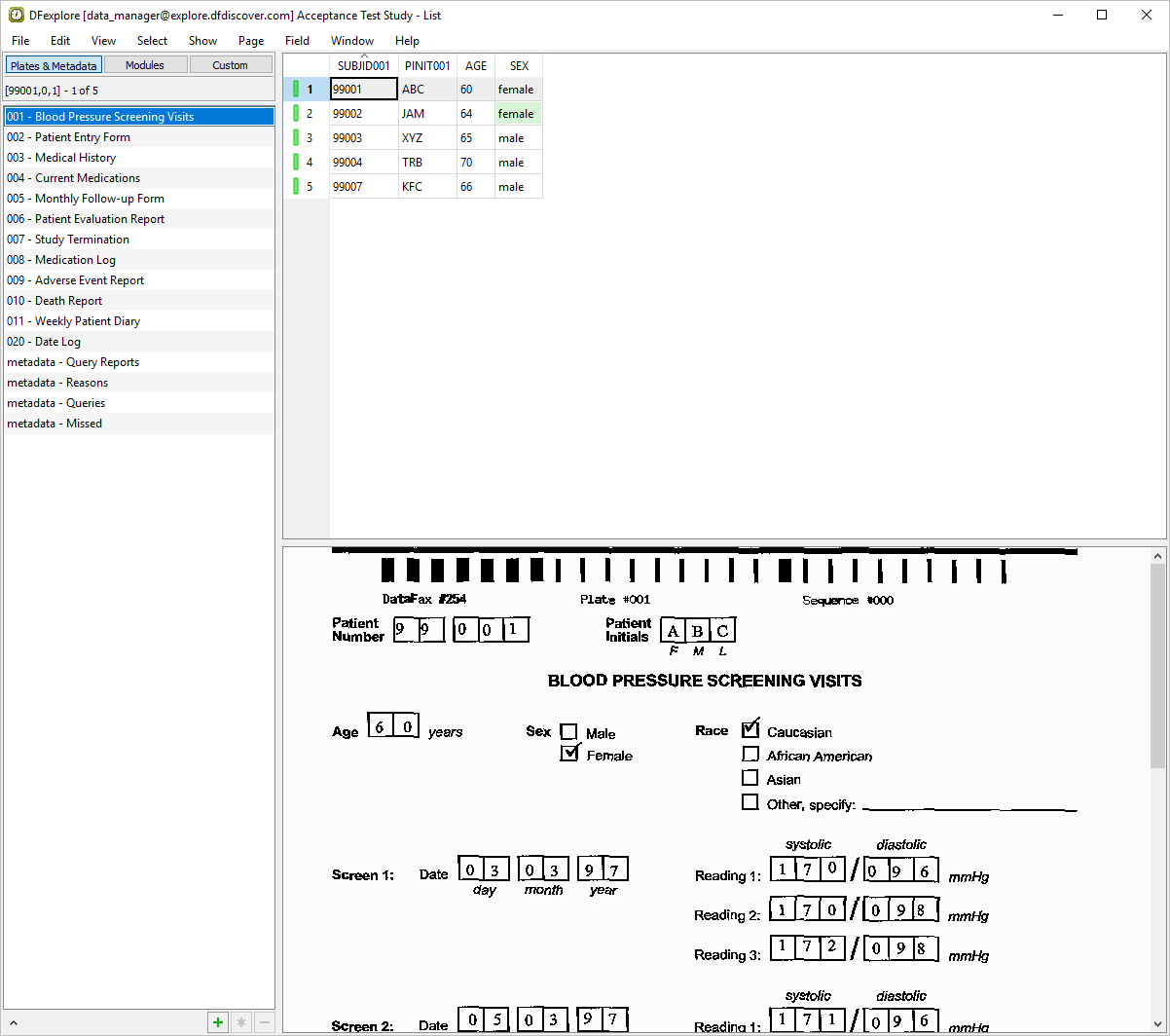
-
To search for specific subject data, select > . Enter
99003in the Subject field.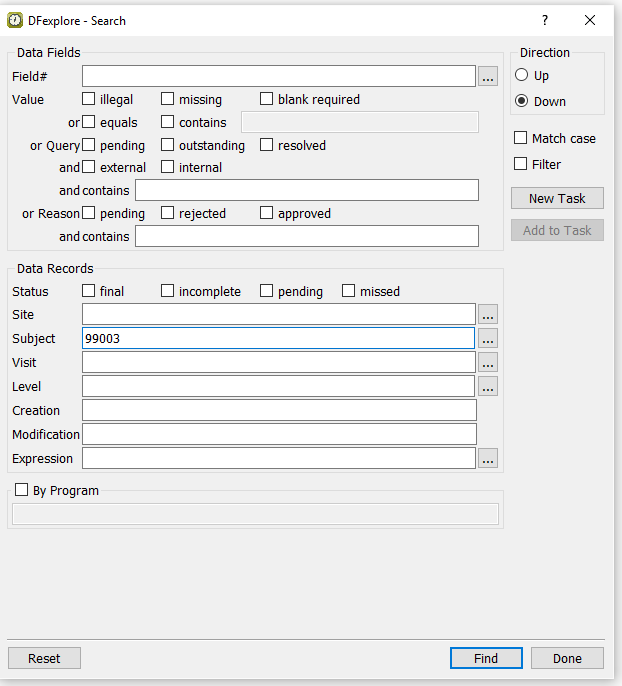
-
Click to start the search. Examine the message in the bottom-left corner of the dialog as well as the highlighted entry in the List View table.
-
Click to locate a 2nd match (if one exists) in the List View table.
-
Click to create a task set of records that match the search criteria. In the resulting dialog, change the Mode to View.
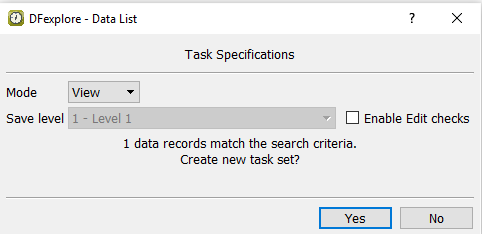
-
Click in the Data List dialog to create the task set. Examine the message in the bottom-left corner of the Search dialog, then click to close the dialog.
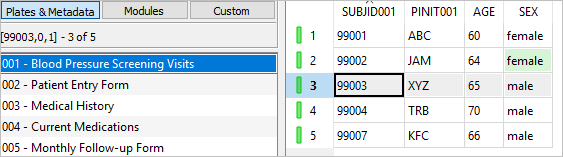
-
Click to open Data View and review the List View task record. Examine the Data View record list and confirm that only the task record for Subject 99003 is displayed. Click .
-
Select > . In the dialog, locate the List View panel. Choose default for Display date field as. Click to save the setting and close the dialog.
-
Click 007 - Study Termination to make it the current page. Select > to open the Search dialog.
-
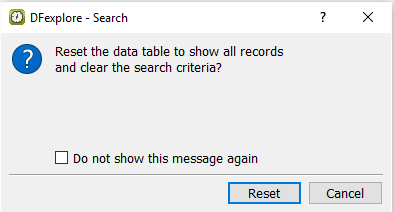
Click and in the resulting dialogs to clear all previously specified search criteria.
-
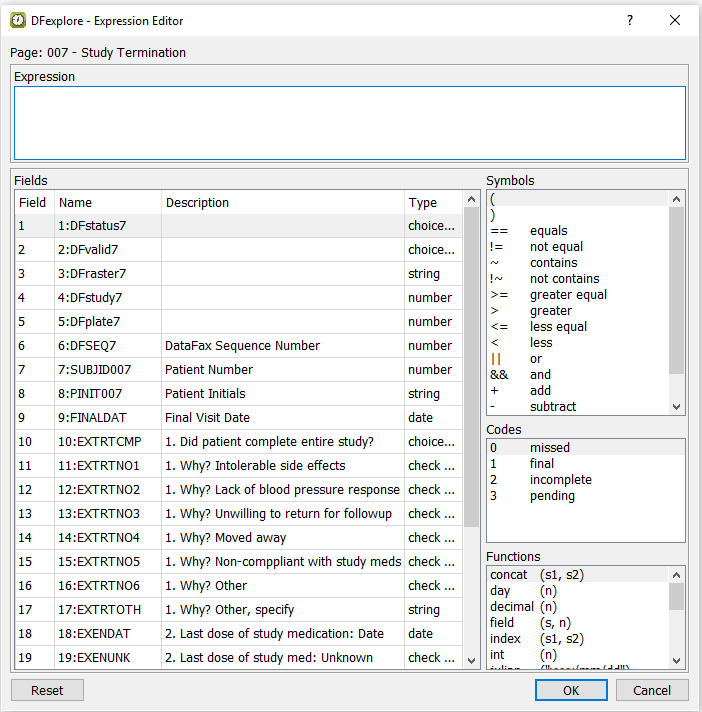
Click next to the Expression field. The Expression Editor opens.
-
For the first part of the query, select 9:FINALDAT from the Fields table. Next, click in the Symbols list. Choose julian from the Functions list. In the Expression field, enter the date
"1997/01/01"(including the quotes). Close the parentheses. To build the second part of the query, click From the Symbols list, followed by field 9:FINALDAT from the Fields table. Next, click in the Symbols list. Choose julian from the Functions list. In the Expression field, enter the date"1997/06/30"(including the quotes). Close the parentheses. Click .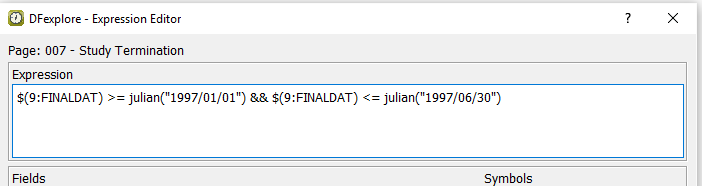
-
Click to locate all subjects that have study termination dates that match the specified search expression.
-
Click to locate the next match.
-
Do not continue the search and click to close the Search dialog.
-
Select > . The DFsas dialog opens.
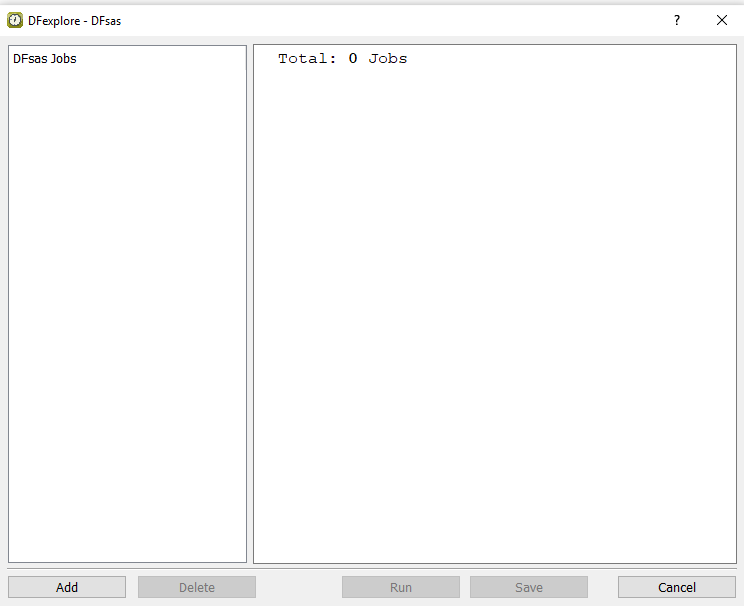
Note If you have previously executed this module as
data_manager, the DFsas Jobs panel may display jobfile1 and possibly other files. If jobfile1 is already in the list, highlight jobfile1 and click before continuing with this module. -
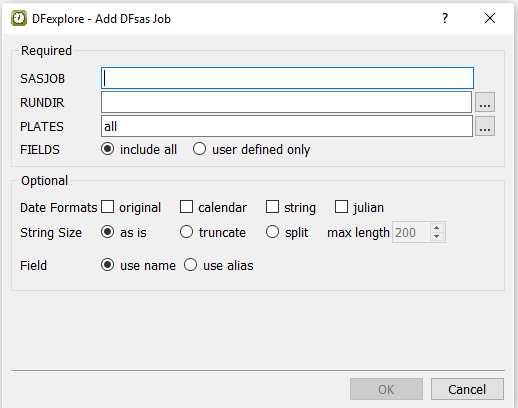
Click to create a new DFsas job.
-
Enter SASJOB =
jobfile1. Click RUNDIR to display the file selection dialog. Choose a directory to save "jobfile1" and click .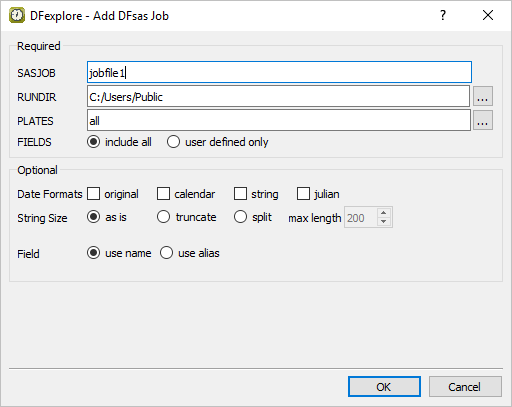
Note The RUNDIR directory was specified as
C:\Users\Public\in this example. Given the directory structure on your local computer, you may have chosen a different value for RUNDIR. -
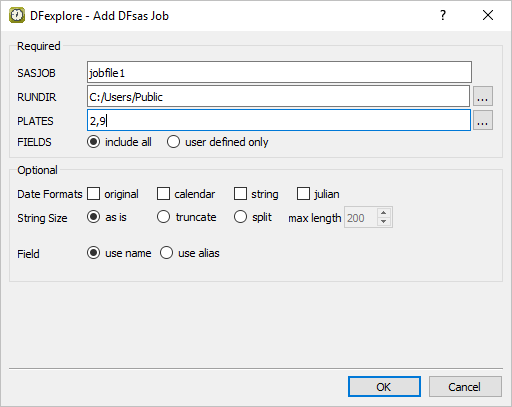
Click PLATES to view all defined study plates. From the list, hold Control key (Command on macOS) and click the entries for 002 - Patient Entry Form and 009 - Adverse Event Report to highlight them. Click . Choose FIELDS = include all.
-
In the Optional panel set:
Check (enable) only calendar for Date Formats
String Size = as is
Field = use alias
Click to create and add
jobfile1.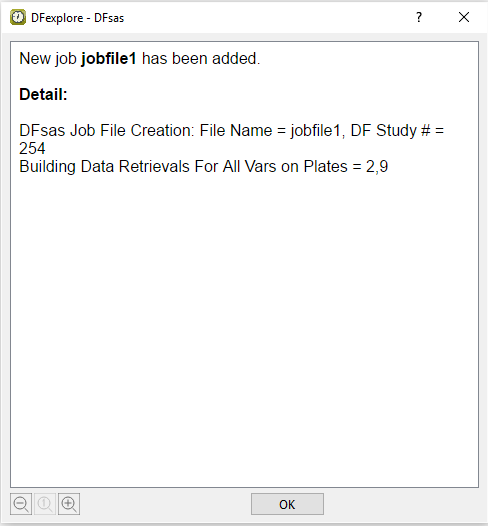
-
Click in the summary confirmation dialog.
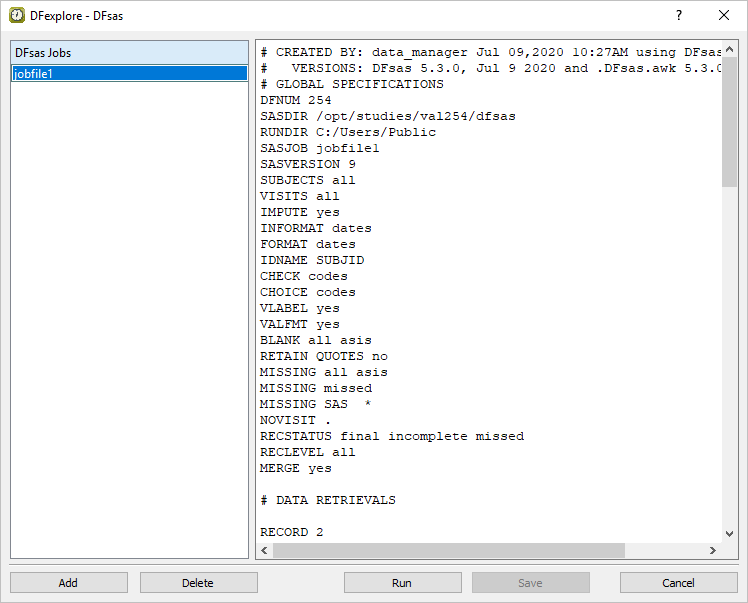
-
Edit the SUBJECTS global specification in the new
jobfile1by selecting it from DFsas Jobs panel. In the main window, change the textSUBJECTS alltoSUBJECTS 99001,99002. This will limit the created SAS data files to subjects 99001 and 99002 only.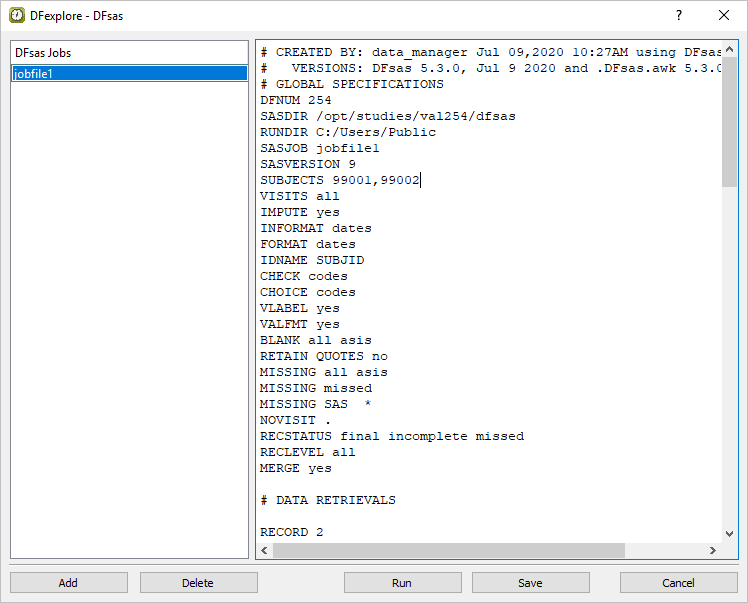
-
Locate the global specifications for CHECK and CHOICE. Change
CHECK codestoCHECK labelsandCHOICE codestoCHOICE labels.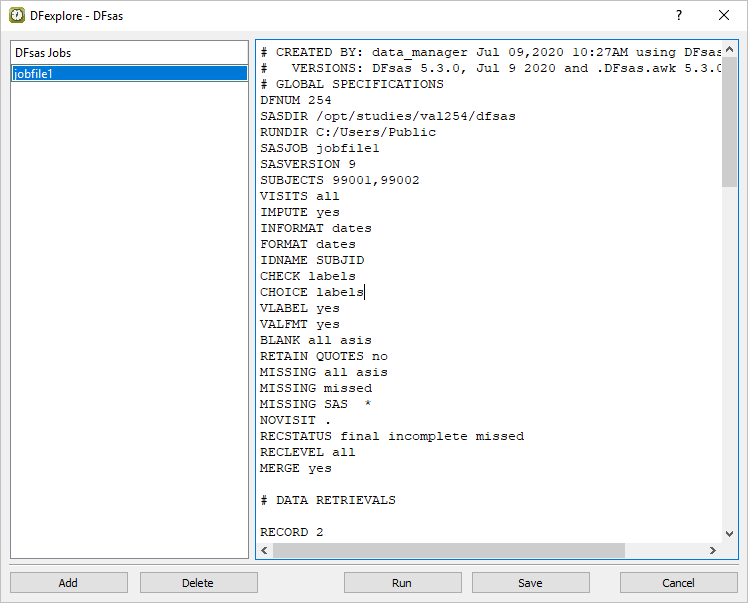
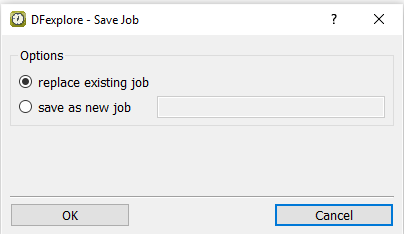
-
Click to save the changes. In the resulting confirmation dialog, choose replace existing job and click .
-
In the DFsas window, highlight
jobfile1. Click to create SAS job and data files.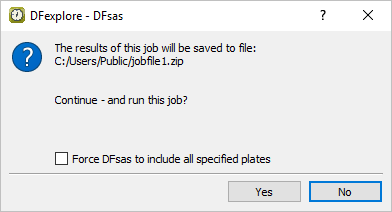
-
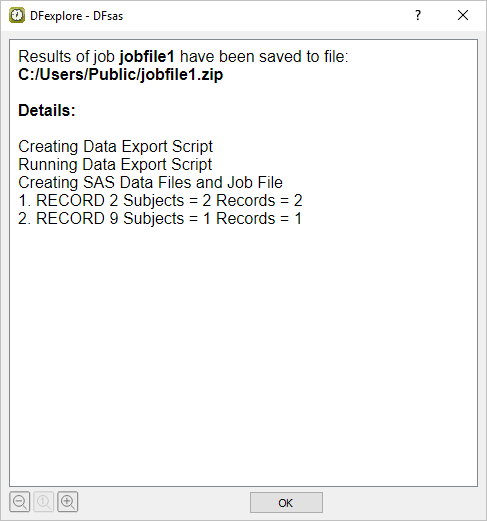
In the confirmation dialog, do not check Force DFsas to include all specified plates. The SAS job and data files will not include empty plates. Click to continue and run the DFsas job. After a pause while the job runs, the results dialog appears. Click to close the dialog.
-
Using the file explorer, locate the directory previously specified as the value of RUNDIR. Confirm that
jobfile1.zipis present. Double-clickjobfile1.zipto unzip the file. Open thejobfile1folder and confirm that the filesjobfile1,jobfile1.sas,jobfile1.d01andjobfile1.d02are present. -
With a text editor, open the data file
jobfile1.d01. Examine the contents and confirm that it contains 2 data records - one for each of subjects 99001 and 99002. Print the file (you will need to reference this printed output in Section 15.9, “Compare the contents of SAS data files with the actual data in the database.”) and then close the text editor application. -
With the same text editor, open the data file
jobfile1.d02. Examine the contents and confirm that it contains 1 data record. Print the file (you will need to reference this printed output in Section 15.9, “Compare the contents of SAS data files with the actual data in the database.”) and then close the text editor application.
-
Click to dismiss the DFsas dialog. Select > . Without changing any settings, click .
-
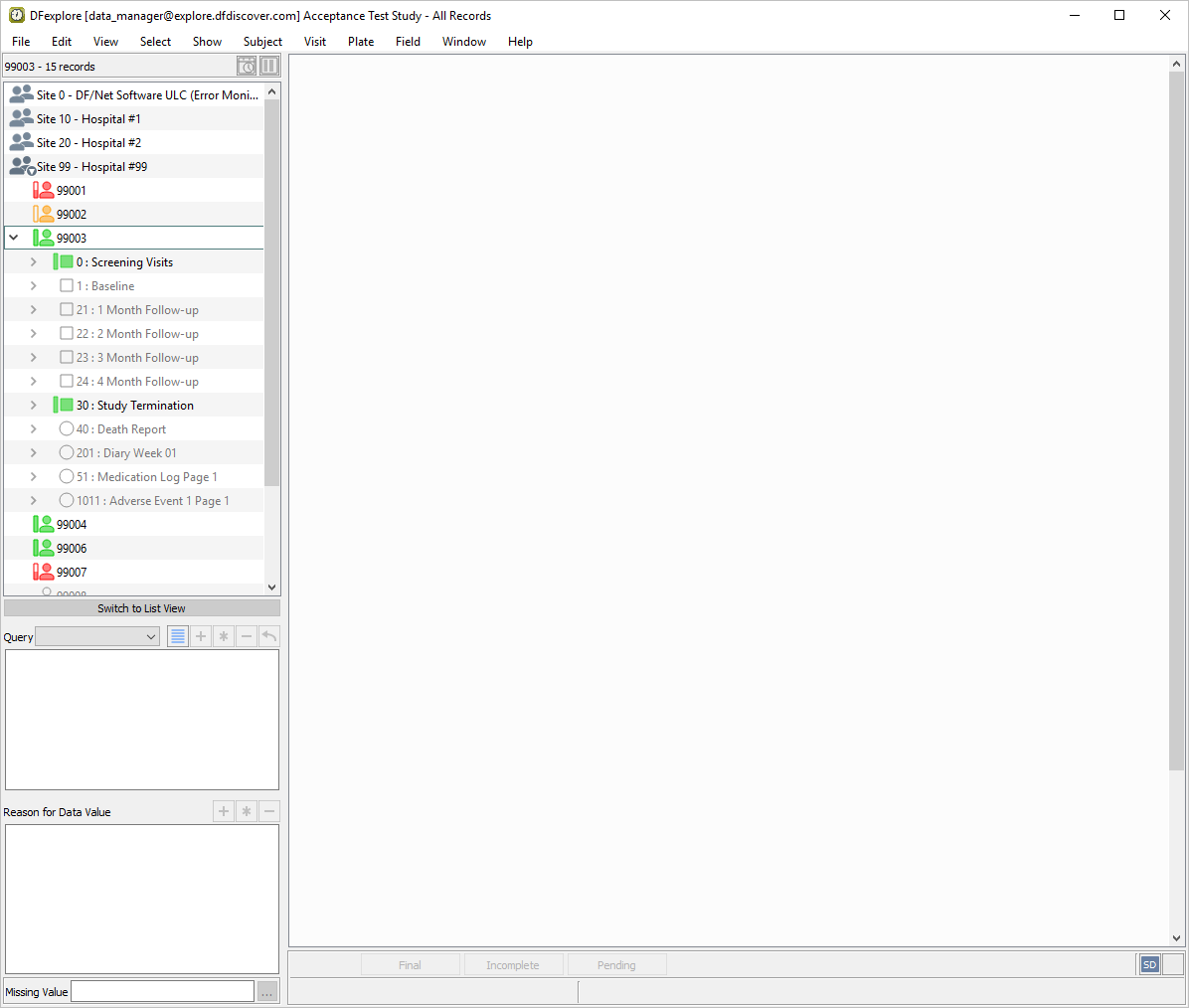
Select > to change from List View to Data View. In the record list, double-click icon for the open Subject 99003 to close the subject binder. The list now displays all subjects for Site 99 - Hospital #99.
-
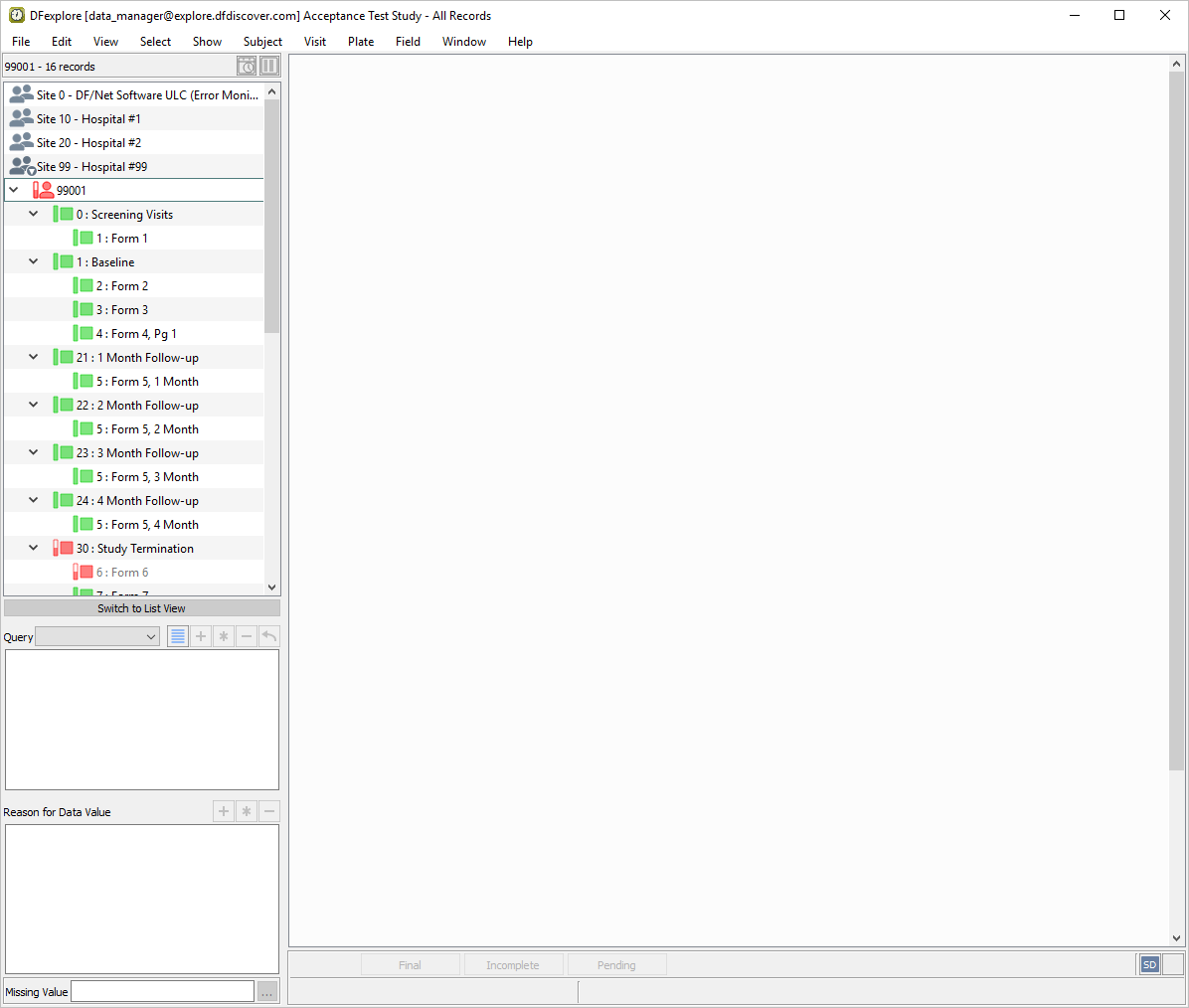
Double-click Subject 99001. Select > . Locate the entry for 2: Form 2 within the 1 : Baseline visit and select it from the list to open the data record.
-
Compare the values in each field of the data record with those values in the printout of the data file
jobfile1.d01. -
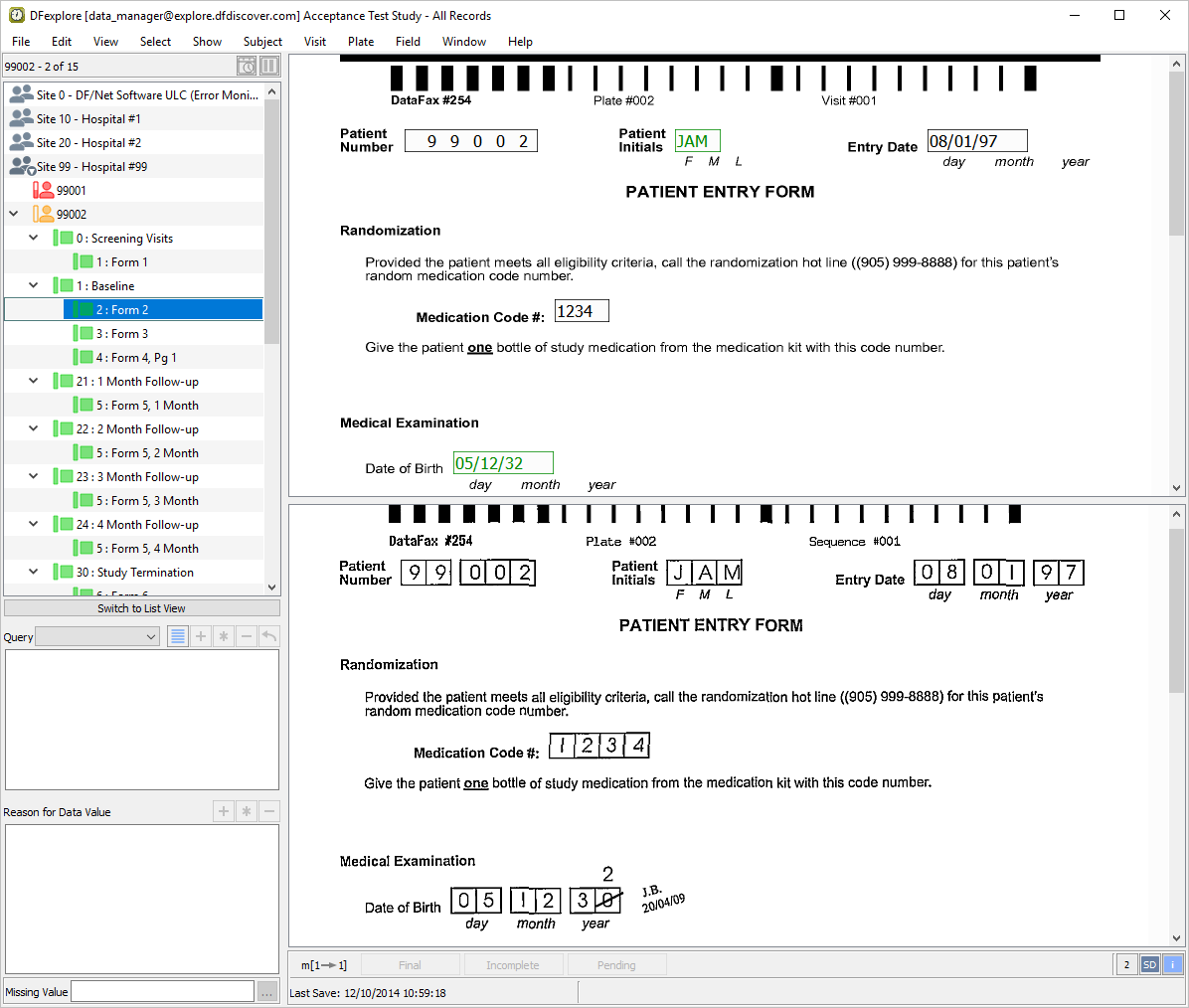
Double-click Subject 99002 from the record list. Select > . Locate the entry for 2: Form 2 within the 1 : Baseline visit and select it from the list to open the data record.
-
Beginning with Subject 99002, Baseline, Form 2, compare the values in each field of the data record with those values in the printout of the data file
jobfile1.d01. -
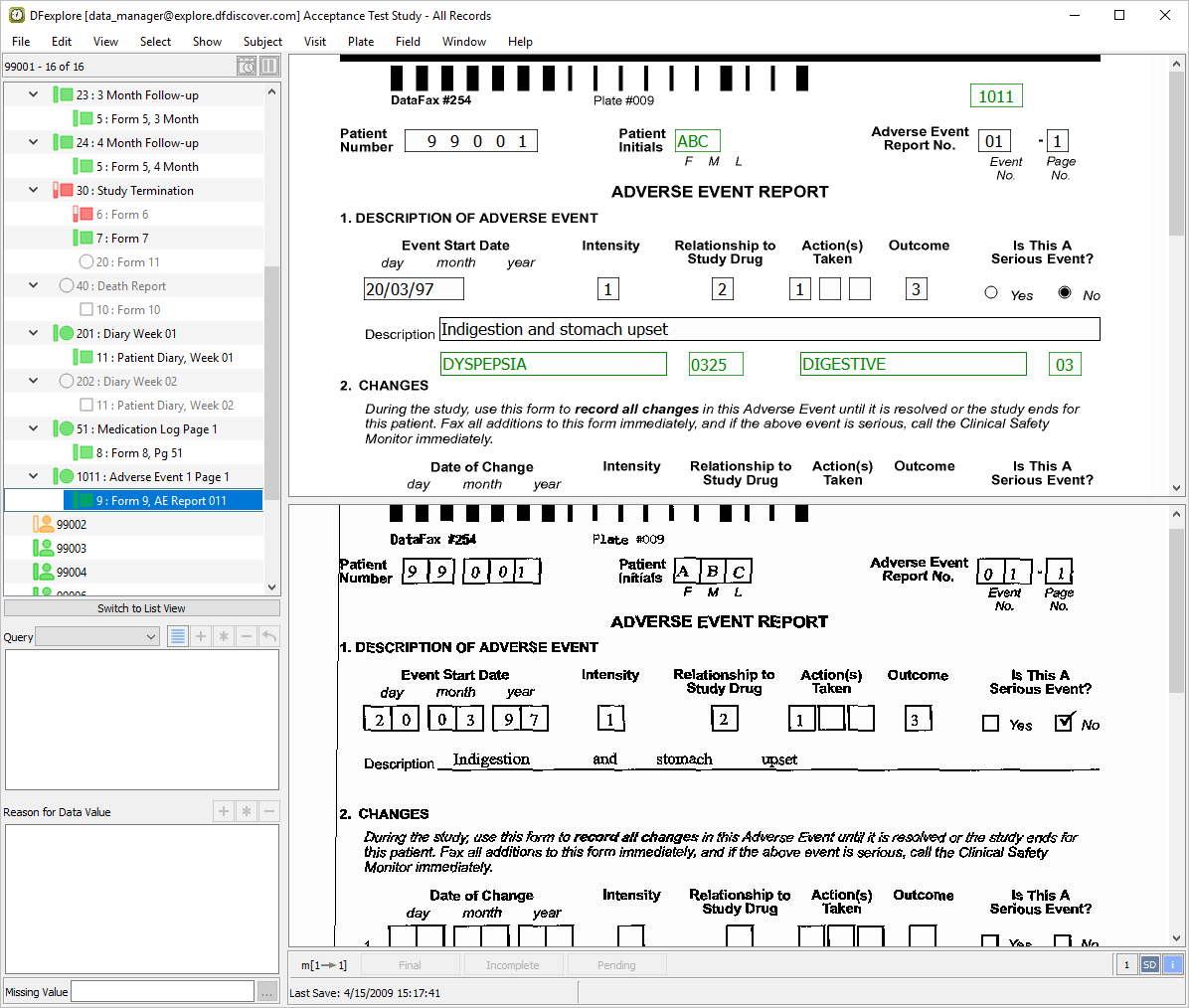
Double-click Subject 99001 to re-open the subject binder. Select > . Locate the entry for 9: form 9, AE Report 011 within the 1011: Adverse Event 1 Page 1 visit and select it from the list to open the data record.
-
Compare the values in each field of the data record in DFexplore with those values in the printout of the data file
jobfile1.d02. -
Select > to close DFexplore.